Table of Contents
- What Is a Diamond Finder?
- Introduction
- Digital Diamond Finders: Retail & Inventory Search Engines
- Field Diamond Prospecting: Finding Diamonds in Nature
- Diamond Detection Technology & Mobile Apps
- Step-by-Step: How to Use Digital Diamond Search Engines
- Diamond Finder Tools & Methods Compared
- Expert Tips & Edge Cases
- Common Mistakes to Avoid
- Best Practices for Every Intent
- Recommended Tools & Resources
- Internal Linking Suggestions
- External Authority References
- Key Takeaways
- Conclusion
- Frequently Asked Questions
What Is a Diamond Finder?
A diamond finder refers to three distinct tools: digital search software used by jewelry shoppers to filter certified loose diamonds, electronic detectors used by gemologists to verify diamond authenticity, and field techniques used by prospectors to locate natural diamonds in rock and alluvial deposits.
For jewelry buyers, a digital diamond finder aggregates diamond inventories from manufacturers across parameters like carat, cut, color, clarity, and certification (GIA or IGI). For prospectors, diamond finding relies on identifying indicator minerals like pyrope garnet and chrome diopside in gravels or kimberlite formations.
Key Takeaways:
- Digital diamond finders allow buyers to compare loose natural and lab-grown diamonds across wholesale networks.
- Electronic diamond testers measure thermal and electrical conductivity; smartphone apps cannot detect physical diamonds.
- Field prospecting requires searching specific geological formations like lamproite pipes and river gravels.
Searching for the term “diamond finder” leads to very different results depending on what you need. A jewelry shopper wants software to filter cut stones by color and price, while a geology enthusiast looks for field techniques to identify rough crystals in river beds.
This guide breaks down every aspect of diamond finding. You will learn how online diamond aggregation tools work, how professional testers verify authenticity, and how field prospectors locate rough diamonds in nature.
Whether you are designing an engagement ring, testing inherited jewelry, or planning a prospecting trip, this guide covers the practical methods, technical details, and tools you need.
Digital Diamond Finders: Retail & Inventory Search Engines
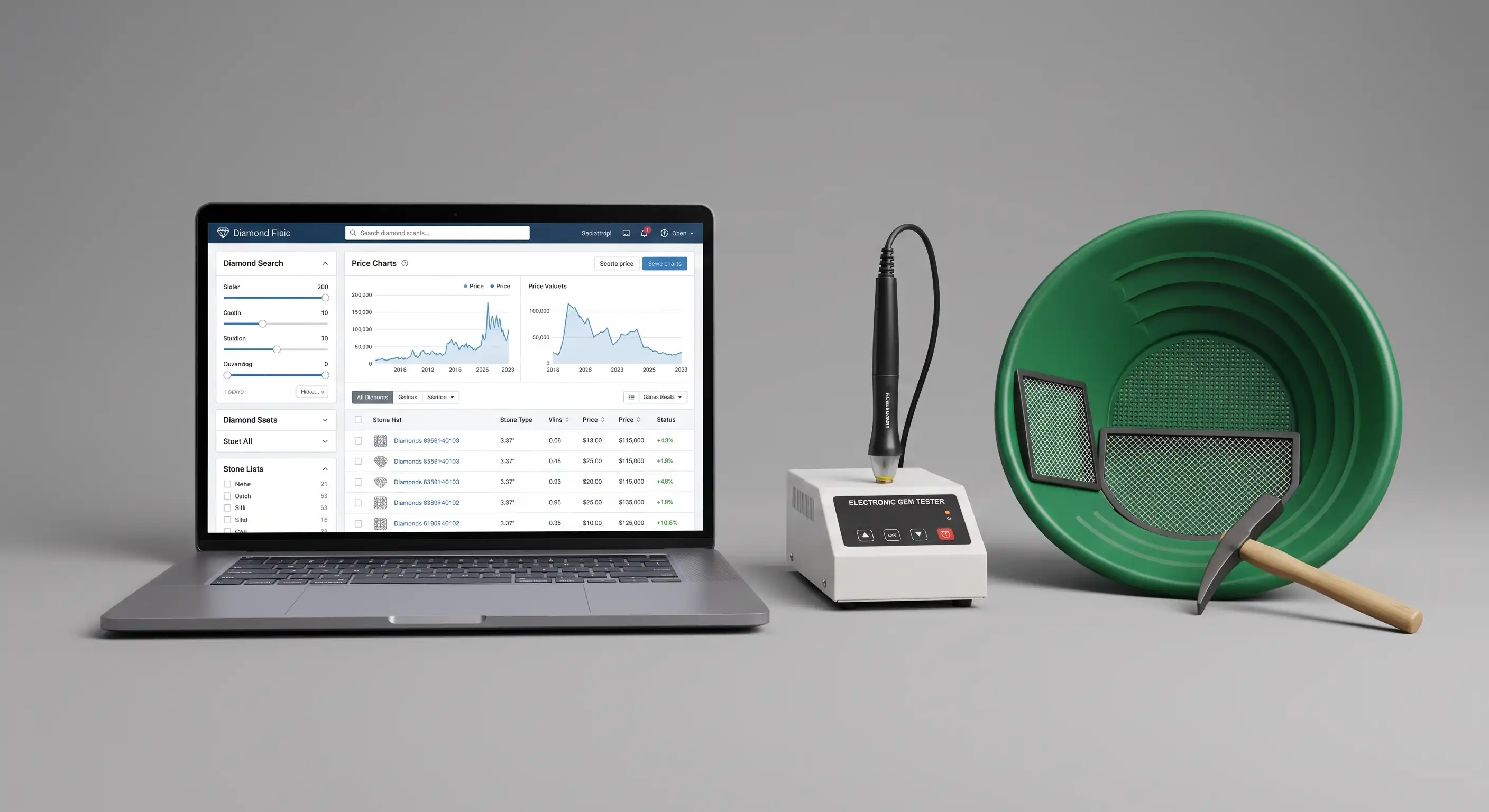
Digital diamond finders are database engines used by jewelers and consumer websites. They aggregate thousands of loose natural and lab-grown diamonds into a single searchable interface.
These databases pull real-time inventory from global diamond cutters and siteholders through API connections. This lets buyers compare identical quality grades across multiple vendors to find fair market pricing.
Key Parameters in Digital Search Engines
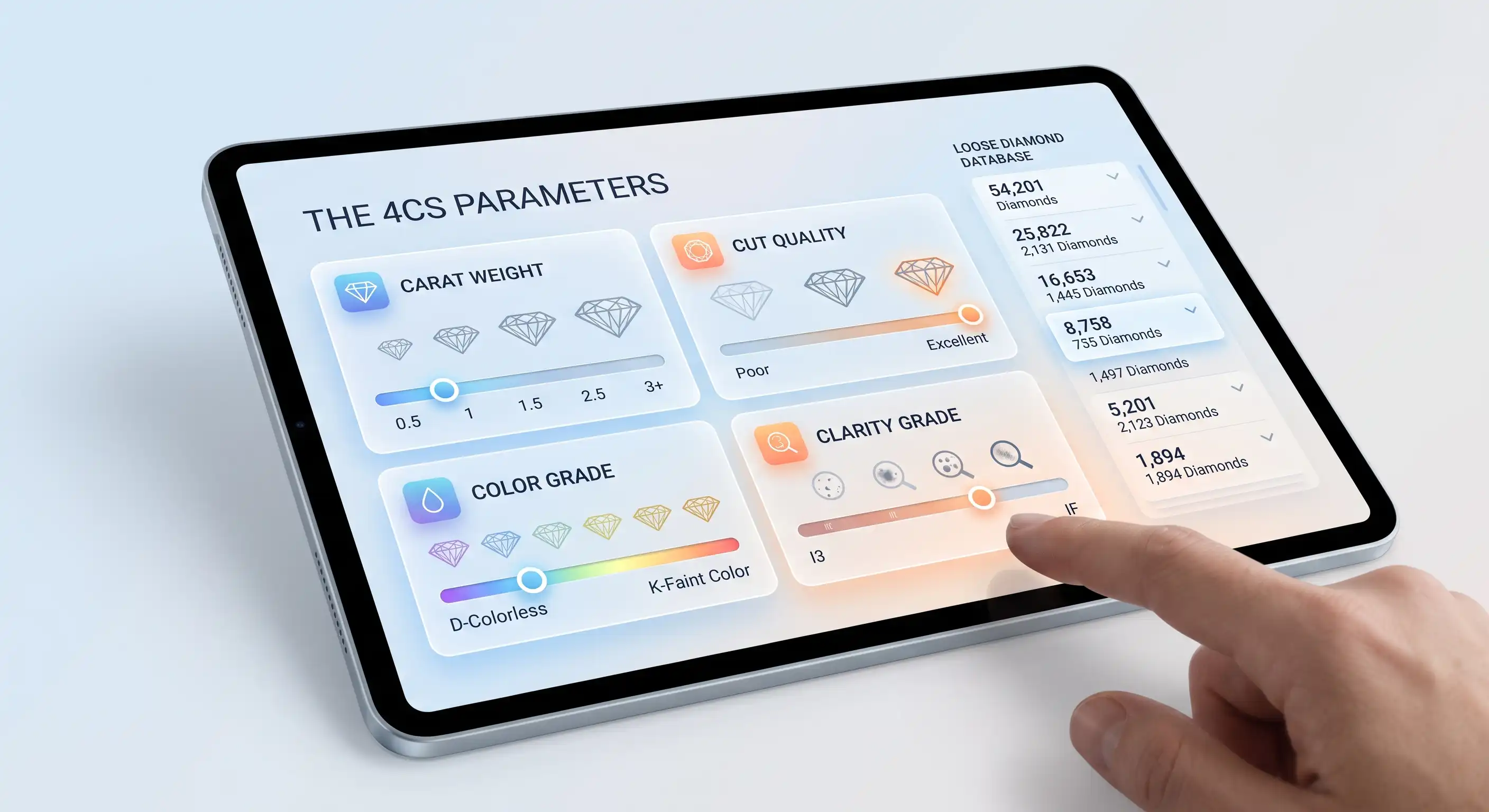
Effective diamond search engines filter inventory using the traditional 4Cs alongside advanced light performance metrics:
- Carat Weight: Measures physical mass (1 carat = 0.2 grams). Search engines let users set narrow ranges, such as 0.90 to 0.99 carats, to find value right below round weight thresholds.
- Cut Quality: Evaluates facet geometry, symmetry, and polish. High-end tools include proportions like table percentage, depth percentage, crown angle, and pavilion angle.
- Color Grade: Ranges from D (colorless) to Z (light yellow or brown). Search engines allow comparisons between adjacent grades to spot subtle visual differences.
- Clarity Grade: Assesses internal inclusions and surface blemishes from Flawless (FL) down to Included (I3). Advanced tools filter out specific inclusion types like clouds or knots.
- Certification Laboratory: Filters results by grading entities like the Gemological Institute of America (GIA) or the International Gemological Institute (IGI).
Advanced Digital Filters: Proportion Ratios and Light Performance
Basic filters cover standard grading metrics, but advanced digital tools analyze specific facet angles that dictate brilliance and fire:
| Proportion Metric | Ideal Range (Round Brilliant) | Visual Impact |
|---|---|---|
| Table Percentage | 54% – 57% | Balances light dispersion (fire) and light return (brilliance). |
| Depth Percentage | 61% – 62.5% | Prevents light leak through the bottom of the stone. |
| Crown Angle | 34.0° – 35.0° | Directs incoming light into fire dispersion. |
| Pavilion Angle | 40.6° – 41.0° | Reflects light straight back through the top table facet. |
Natural vs. Lab-Grown Filters
Modern inventory finders keep natural and lab-grown diamonds in distinct databases because of their different pricing structures and origins.
Natural diamonds are valued based on rarity and historic market trends. Lab-grown diamonds, produced via Chemical Vapor Deposition (CVD) or High Pressure High Temperature (HPHT), are valued primarily on production costs and scale.
Field Diamond Prospecting: Finding Diamonds in Nature
Locating rough diamonds in nature requires understanding specific geological formations. Unlike gold, diamonds are rarely found in pure vein deposits; they form under extreme heat and pressure deep in the Earth’s mantle.

Host Rocks: Kimberlite and Lamproite Pipes
Diamonds travel to the Earth’s surface through volcanic eruptions that create narrow vertical geological structures called pipes.
- Kimberlite Pipes: Potassic ultrabasic igneous rocks that serve as the primary host structure for most natural diamond deposits worldwide.
- Lamproite Pipes: Ultramafic volcanic rocks that also carry diamonds, as seen in famous deposits like the Argyle mine in Western Australia.
Indicator Minerals in Prospecting
Rough diamonds make up a tiny fraction of the material in a pipe. Prospectors track denser, more common heavy minerals that travel alongside diamonds to find viable sites:
- Pyrope Garnet (G10/G9): Deep red to purple garnets that signal mantle conditions suitable for diamond formation.
- Chrome Diopside: Bright, emerald-green silicate minerals that indicate kimberlitic magma.
- Picroilmenite: Magnesium-rich ilmenite that shows whether host magma preserved diamonds during transit to the surface.
- Spinel / Chromite: Dark metallic minerals often found alongside heavy alluvial deposits.
Alluvial Prospecting Techniques
Over millions of years, weathering breaks down volcanic pipes. Streams and rivers wash host rock away, carrying heavy diamond crystals downstream into gravel beds.
Prospectors use gravity separation to pull rough stones out of gravel deposits because diamond has a specific gravity of 3.52, making it noticeably denser than standard quartz sand (2.65).
Field Note: Rough diamonds do not look like polished gems. They usually appear as smooth, oily octahedral (eight-sided) crystals with rounded edges, resembling slick pieces of glass or gum arabic.
Diamond Detection Technology & Mobile Apps
A common point of confusion comes from smartphone apps claiming to find diamonds. Understanding how genuine testing hardware works helps prevent costly mistakes.
How Electronic Diamond Testers Work
Professional gemologists and jewelers use handheld electronic testers based on physical material properties:
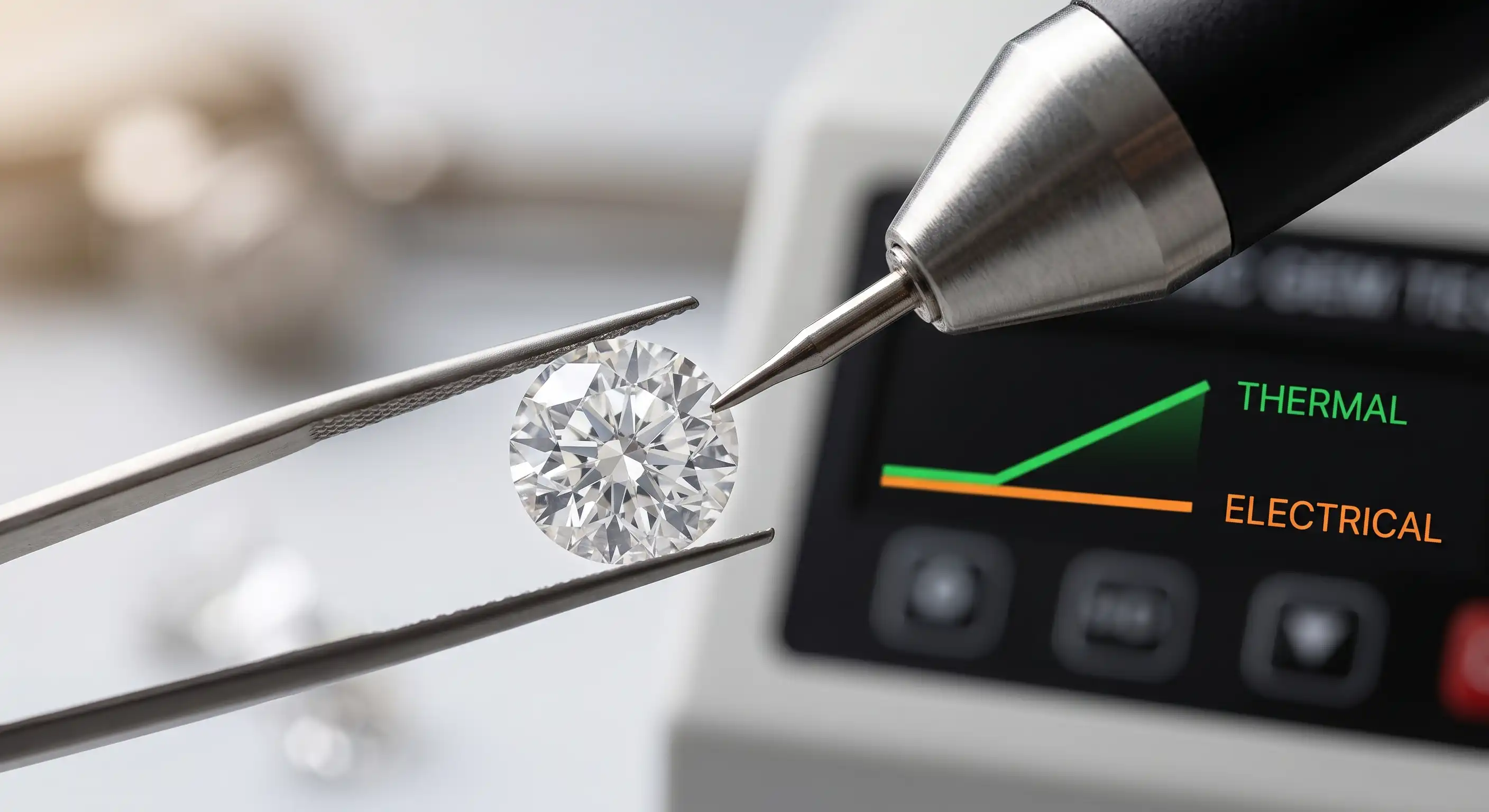
- Thermal Conductivity Testers: Diamond conducts heat faster than almost any other solid material. Thermal testers push a brief heat pulse through a copper tip; if the heat dissipates instantly, the tool signals a real diamond. However, synthetic moissanite also conducts heat rapidly, which can fool basic thermal units.
- Electrical Conductivity Testers: To distinguish diamond from moissanite, dual-mode testers measure electrical resistance. Moissanite conducts electricity slightly, whereas almost all natural and lab diamonds (except rare Type IIb blue diamonds) are electrical insulators.
- UV and Spectroscopy Equipment: Advanced laboratory tools use UV luminescence, Raman spectroscopy, and photoluminescence to detect trace elements like nitrogen, identifying whether a diamond is natural, lab-grown, or color-treated.
Can Smartphone Apps Find Diamonds?
No mobile app can turn a smartphone into a physical diamond detector or mineral scanner. Smartphones lack the specialized thermal probes and UV light sensors required to measure gemstone physical properties.
Mobile apps labeled “diamond finders” fall into two categories: shopping tools for browsing diamond ring inventories, or casual entertainment games. Never use a smartphone camera or metal detector app to verify gemstone authenticity.
Step-by-Step: How to Use Digital Diamond Search Engines
To find the best value on a diamond using digital search engines, follow this structured process to narrow down stone databases efficiently.
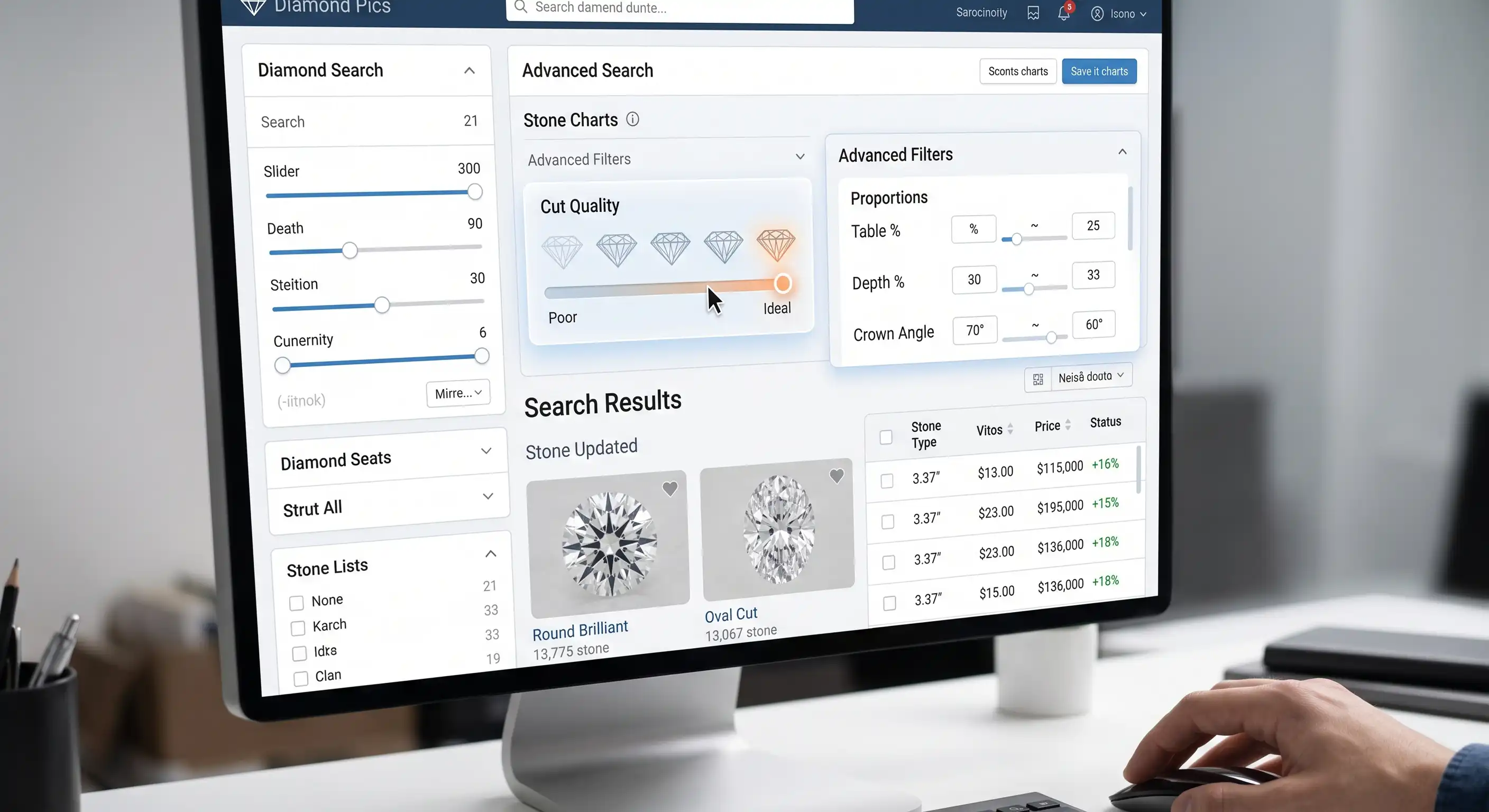
Step 1: Set the Cut Quality Threshold First
What: Lock the cut quality slider to “Ideal” or “Excellent” before adjusting any other parameter.
Why: Cut quality controls how light moves through the diamond. A poorly cut stone looks dull even with perfect D color and VVS1 clarity.
How: On your search engine, select only the top cut grade available. For round stones, filter for Excellent (GIA) or Ideal (AGS).
Pro Tip: For fancy shapes like oval, cushion, or emerald cuts, check depth and table percentages directly, as grading labs do not assign a standardized cut grade to non-round shapes.
Step 2: Choose Your Target Carat Weight Range
What: Define a narrow weight range slightly below popular rounded numbers.
Why: Diamond prices rise sharply at full-carat markers like 1.00, 1.50, and 2.00 carats. A 0.92-carat diamond offers virtually the same visual footprint as a 1.00-carat stone at a much lower price point per carat.
How: Enter custom ranges like 0.90–0.98 carats or 1.40–1.48 carats into the inventory filter.
Step 3: Optimize Color and Clarity Based on Metal Selection
What: Balance color and clarity settings based on your setting choice and diamond shape.
Why: Yellow or rose gold settings absorb gem color, allowing you to choose G, H, or I color grades without seeing warm tones. White gold or platinum settings showcase subtle body color, so stick to D through F grades if you want a icy white look.
How: Filter clarity to VS2 or SI1. View high-resolution 360-degree videos to confirm the stone is “eye-clean,” meaning inclusions are invisible without magnification.
Common Mistake: Paying extra for VVS1 or Flawless clarity. These inclusions are microscopic and offer no visual difference to the naked eye under everyday lighting.
Step 4: Verify Certification and Fluorescence
What: Filter search results exclusively for reputable grading reports and check fluorescence notes.
Why: Uncertified stones or reports from lenient labs often inflate color and clarity grades. Additionally, strong blue fluorescence can cause lower-color stones to look whiter, but may make high-color stones look milky under direct sunlight.
How: Check the GIA or IGI certificate box in the search menu. Filter fluorescence to “None” or “Faint” for D-F color stones, or “Medium Blue” for H-J color stones to improve visual whiteness.
Diamond Finder Tools & Methods Compared
This breakdown compares digital search engines, hardware testers, and physical field prospecting methods side by side.
| Tool / Method | Primary Purpose | Target User | Accuracy / Reliability | Cost Range |
|---|---|---|---|---|
| Digital Aggregator Software | Search loose polished diamond inventory globally | Jewelry shoppers & buyers | High (based on lab certificates) | Free to use |
| Dual Thermal/Electrical Tester | Verify physical diamond vs. moissanite/simulants | Jewelers, pawnbrokers, buyers | Very High (for basic material separation) | $150 – $500 |
| Alluvial Pan & Screen Set | Separate rough minerals from river gravel | Field prospectors & rockhounds | Depends on location & user skill | $30 – $120 |
| Spectroscopy Lab Unit | Distinguish natural vs. lab-grown diamonds | Gemological laboratories | Near 100% accurate | $5,000 – $40,000+ |
Expert Tips & Edge Cases
Spotting “BGS” (Brown, Green, Milky) Undertones in Digital Listings
Search engine listings do not always state when a diamond has an unwanted secondary body tone or milky haze caused by dense microscopic inclusions. Always inspect high-resolution video listings under direct lighting to spot cloudy transparency issues that certificates miss.
Identifying Diamond Inclusions in the Field
When searching for rough diamonds in gravel deposits, do not rely on surface color. Look for adamantine luster—a characteristic slick shine that resists water—and test for extreme hardness. Diamonds will easily scratch corundum (sapphire/ruby), which sits at 9 on the Mohs hardness scale.
Navigating Fancy Shape Ratios
Digital diamond finders require careful ratio filtering when searching for non-round diamond shapes:
- Oval Cuts: Target a length-to-width ratio between 1.35 and 1.50 for a classic outline. Check 360-degree videos to avoid severe “bow-tie” shadows across the center facets.
- Emerald Cuts: Aim for a ratio between 1.30 and 1.50. Step cuts highlight inclusions easily, so keep clarity at VS2 or higher.
- Princess Cuts: Choose a length-to-width ratio between 1.00 and 1.05 for a clean, square appearance.
Common Mistakes to Avoid
1. Confusing Diamond Selectors with Metal Detectors
Metal detectors respond to magnetic permeability and electrical conductivity in metals like gold, silver, and copper. Diamonds are non-metallic insulators and generate zero signal on standard metal detectors. Do not purchase a metal detector expecting to locate unmounted gems in soil.
2. Buying Stones Based on Certificate Data Alone
A GIA report confirms a stone’s dimensions and grade, but it does not tell you where inclusions sit within the diamond. A dark inclusion right in the middle of the table facet impacts beauty much more than a crystal hidden near the girdle edge.
3. Trusting Basic Thermal-Only Pen Testers
Cheap thermal pen testers frequently flag synthetic moissanite as diamond because both materials conduct heat rapidly. Always use a dual-mode tester that measures electrical conductivity alongside thermal response.
4. Overpaying for High Clarity and Color
Buying a D color, Flawless clarity diamond often wastes budget on grades that offer no visible difference to the naked eye. Shifting to an F or G color with a clean VS2 clarity yields a visually identical diamond while saving considerable money.
Best Practices for Every Intent
- For Engagement Ring Buyers: Prioritize Cut quality above every other metric. A well-cut diamond reflects light effectively, helping the stone look larger and brighter.
- For Field Prospectors: Focus on mapping indicator mineral zones before sifting gravel. Locating concentration areas for pyrope garnets and chrome diopside boosts your odds of finding rough stones.
- For Estate and Antique Gem Buyers: Combine thermal testing with magnification loupe inspections. Look for wear along facet edges; glass and cubic zirconia show small chips and rounded facet junctions, whereas diamond facets stay sharp.
Recommended Tools & Resources
Here are reliable tools and reference platforms across digital search, testing, and field work:
- Online Diamond Engines: Search aggregators like Rare Carat, Blue Nile, and James Allen offer robust inventory filters alongside GIA/IGI grading reports and 360-degree video listings.
- Hardware Testers: The Presidium Gem Tester II and the AlfaMirage AGT3 provide accurate thermal and electrical separation for retail environments.
- Geological Resources: Regional USGS (United States Geological Survey) mineral databases offer maps detailing historic kimberlite locations and gravel deposits.
Related Guides and Articles
Explore these related resources to learn more about gemstone evaluation and purchasing:
- Understanding Diamond Cut Quality: Proportions, Polish, and Light Return
- Lab-Grown vs. Natural Diamonds: Price, Value, and Production Differences
- How to Inspect Inclusions Using a 10x Triplet Gem Loupe
- Prospector’s Guide to Indicator Minerals: Garnets, Diopside, and Spinel
- Engagement Ring Budgeting: Smart Spending Across Cut, Color, and Carat
External Authority References
For research, technical documentation, and geological data, consult these primary sources:
- Gemological Institute of America (GIA): The primary authority on diamond grading standards, facet proportion research, and education materials.
- International Gemological Institute (IGI): Global laboratory providing synthetic and natural diamond certification reports.
- United States Geological Survey (USGS): Government resource for geological maps, soil reports, and mineral deposit studies.
Key Takeaways Summary
- Digital diamond finders streamline searches by aggregating inventories and filtering for cut, color, clarity, and proportion angles.
- Field prospecting relies on identifying indicator minerals like pyrope garnet and chrome diopside within kimberlite and alluvial deposits.
- Hardware testing requires dual-mode thermal and electrical units to split natural/lab diamonds from moissanite.
- Smartphone apps cannot detect real diamonds; they serve only as shopping databases or casual games.
- Prioritize cut grade over carat weight or high clarity to maximize brilliance and visual value.
Conclusion
Understanding how diamond finders work across digital retail, field prospecting, and physical verification helps you choose the right approach for your needs.
For jewelry buyers, focusing on cut parameters within online search engines unlocks maximum diamond fire while avoiding unnecessary clarity markups. For prospectors and gem enthusiasts, focusing on geological host formations and using proper dual-mode testing tools ensures reliable results in the field.
Apply these methods to narrow down inventory databases, verify gem authenticity, or scout field locations with confidence.
Frequently Asked Questions
Is there a phone app that can detect real diamonds?
No phone app can detect physical diamonds. Smartphones do not have the thermal probes or electrical sensors needed to measure gemstone properties. Diamond finder apps are either retail inventory tools or casual games.
Can a standard metal detector find diamonds in the ground?
No, standard metal detectors cannot find diamonds. Metal detectors rely on electromagnetic induction to spot conductive metals like gold or silver. Diamonds are non-metallic insulators that do not produce a signal on metal detectors.
What rock type are diamonds most commonly found in?
Natural diamonds are primarily found in igneous rocks called kimberlite and lamproite. These volcanic pipes carry diamonds from the Earth’s mantle up to the surface. Over time, erosion also washes diamonds into alluvial river gravels.
How do online diamond search engines get their diamond inventories?
Online diamond search engines connect directly to diamond cutters, siteholders, and wholesalers using automated API feeds. This aggregates global loose diamond inventories into one searchable marketplace.
What is the most reliable way to test if a diamond is real at home?
The most reliable home testing method is using a dual-mode thermal and electrical conductivity tester. Basic fog or water tests are unreliable, while thermal-only pens can easily mistake synthetic moissanite for real diamond.
Why is cut grade the most important setting in a diamond search tool?
Cut grade determines how light moves through the diamond’s facets and reflects back to your eye. A poorly cut stone looks dim even with flawless clarity and top color, whereas a well-cut stone reflects light effectively and appears larger and brighter.